The 20 internal marks are the ones you will have to defend. CBSE has already written down how.
The 80-mark paper is the board's to justify, and the 20 marks awarded inside your school are yours. The 2026-27 curriculum lists, in some detail, the record it expects you to be able to produce when someone asks.
A parent asks why their daughter got 14 out of 20 and not 17.
You have a number in a spreadsheet. Somewhere there is a register with three test scores, a folder of project sheets, and a teacher who remembers roughly how the class went. What you probably do not have is the reasoning, in one place, dated and ready to put on a table.
The 80-mark paper is the board's to justify. The 20 marks awarded inside your school are yours, and the 2026-27 curriculum is specific about the record it expects you to be able to produce.
25%
each. The four internal assessment components carry equal weight, stated as percentages of the internal marks.
3
periodic assessments per subject per year. The average of the best two is what counts.
2
separate places the curriculum requires rubrics to be shared with students in advance.
How are the 20 internal marks split in 2026-27?
Internal assessment is 20 marks for major subjects, alongside an 80-mark board paper in Class X or a school-conducted annual examination in Class IX. The 20 divides four ways at 25 percent each: Periodic Assessment, Multiple Assessment, Portfolio, and Subject Enrichment Activities. That is §3.3 of CBSE's Secondary Curriculum 2026-27, Part 1.
Note that the curriculum states these as percentages of the internal assessment weightage, not as five marks apiece. That matters, because §3 says the internal component is "20 Marks for major subjects or Marks mentioned in the syllabus of the subject". For a subject where internal assessment is not 20, "five marks each" is simply wrong.
The components are not named or grouped the same way in every subject, and this is what catches schools out. The components as printed in the 2026-27 curricula:
- Social Science: Periodic 5, Multiple 5, Subject Enrichment 5, Portfolio 5.
- English Language & Literature: Periodic 5, Multiple 5, Portfolio 5, Subject Enrichment 5.
- Mathematics: Pen Paper Test and Multiple Assessment (5+5), 10 in one line; Portfolio 5; Lab Practical 5.
Mathematics has no line called Subject Enrichment at all. Its fourth component is Lab Practical, drawn from the CBSE Mathematics Laboratory guidelines and the NCERT laboratory manual. A school that issues one "subject enrichment project" template to every department is not doing what the Mathematics curriculum asks for, and will not discover this until someone checks.
Mathematics also reports Periodic and Multiple Assessment as a single combined 10. The underlying 5+5 is printed, but if your record sheet has one column headed "Pen Paper Test and Multiple Assessment", you cannot show the two halves were ever kept apart. That is the first thing a serious challenge would probe.
The totals are 20 throughout, and the 25 percent rule holds everywhere. Only the labels move, and your record-keeping is built on the labels.
Five things you should be able to put on a table
Strip the scheme down to what is auditable, and it comes to five items. None is exotic; all are stated in the text.
Three periodic assessments per subject, all three recorded
The average of the best two is what counts. Running two is short of what the curriculum asks. Running three but recording only the two you used means nobody can verify the average was computed correctly, which is a different failure and a worse one.
At least one of the three, competency-based
The curriculum is specific about what qualifies: case analysis, data interpretation, problem-solving tasks, open-ended questions, or interdisciplinary contexts. Tag which one it was at the time. Nobody reconstructs this in March.
A rubric for every Multiple Assessment and Portfolio mark, dated before the task
This is the one that actually decides the parent meeting. The curriculum requires rubrics "shared with students in advance" for Multiple Assessment, and again for Portfolio: "assessed using clearly defined rubrics shared in advance". A rubric written after the marks are in can only justify them.
A mapping from each tool to the competency it assesses
Stated flatly: "All Internal Assessment tools shall explicitly map to identified Competencies and Learning Outcomes." One column on the record sheet does it.
Documented remedial action where an assessment showed a gap
Periodic assessments are to "be followed by structured feedback and documented remedial measures where required". Most schools do the remediation and skip the documentation, which means the effort exists and the evidence does not.
None of the five asks for more assessment. Each is about keeping what a school already produces: the third test, the tag, the rubric, the mapping, the note. Most schools already do the work, and most of it leaves no trace.
Is the 33% pass mark separate or combined?
The curriculum does not settle it. Its statement of the pass rule asks for both in one sentence, and this is a point where you should get CBSE's reading in writing rather than take mine. Verbatim:
To be declared successful in a subject, a student must secure a minimum of 33% marks separately in external and internal assessments, calculated on the combined total of Internal Assessment and External Examination marks, as per the prescribed scheme.
"Separately" and "calculated on the combined total" cannot both be true, and the difference decides real results. Take a student with 30 out of 80 in the external paper and 18 out of 20 internally. On the combined reading she has 48 out of 100 and passes comfortably. On the separate reading she has 37.5 percent internally and 37.5 percent externally, so she passes either way. Now move her external mark to 25. Combined, she has 43 and passes. Separately, she is at 31.25 percent externally and fails.
Somewhere in your Class IX cohort this year there is a student on that line. The sentence that decides her result contradicts itself.
Do not resolve this by choosing the reading that suits you. Write to your regional office, quote the sentence, and ask which applies, before results processing, not during it. A written answer costs you one email now and settles an argument you would otherwise have in front of a parent with a marksheet.
Two things this does not change
The two-level scheme does not touch internal assessment. With Mathematics and Science moving to Standard and Advanced levels (what that means for sectioning), the obvious question is whether an Advanced candidate does something different for the 20. The curriculum answers it directly: "This two-level structure will not apply to the internal assessments of 20 marks in Mathematics and Science conducted at the school level in Class X." Same internal assessment, whichever level the student sits.
Portfolio is deliberately pointed at the Holistic Progress Card. The curriculum says the Portfolio component should "align with the philosophy of the Holistic Progress Card (HPC) envisioned in NCFSE 2023". If your school is building HPC evidence and portfolio evidence as two separate exercises, you are doing the heaviest part of both twice. That is a bigger subject than this post, and worth its own.
What to do this month
Internal assessment records are being built right now, and the disputes land in March. Anything you fix before then never reaches a parent meeting.
Pick one subject. Make it Mathematics, because its component names are the ones that differ. Open the record sheet a department is actually using. Ask whether it can show three periodic scores rather than an average, which assessment was the competency-based one, and where the rubric for the portfolio mark is filed with a date on it. If the answer to any of those is "the teacher would know", you have found the thing to fix, and about five months to fix it.
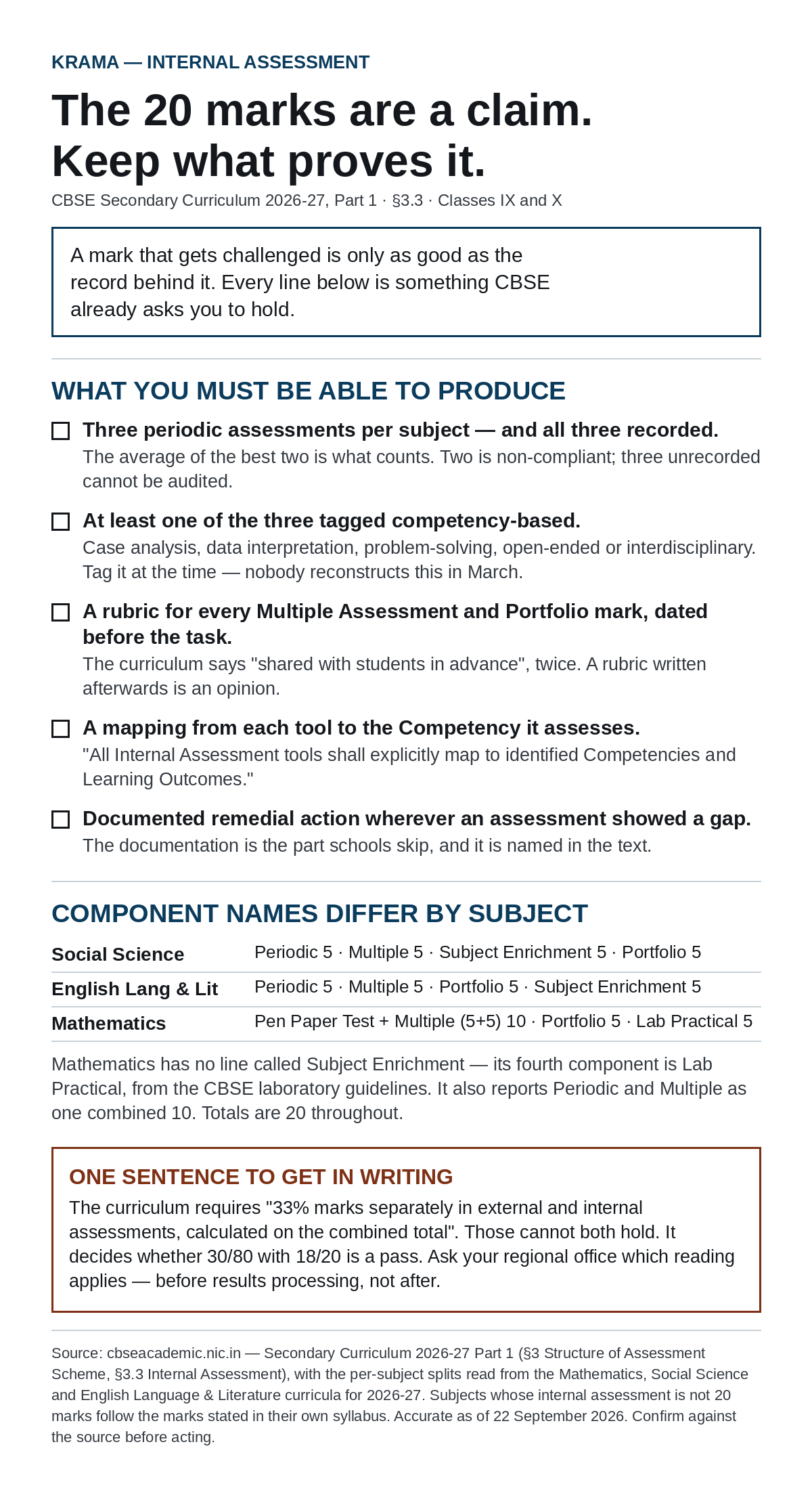
The card above puts that check on one page, written as the evidence to produce, since evidence is what you will be asked for in the meeting.
I would like to know which of the five is hardest in a real school. My guess is the dated rubric, because it asks for a decision before the task instead of a record after it. I would still rather hear it from someone running the register. Which one would your departments struggle with most?
Take this with you
Internal assessment: what you must be able to produce
A one-page evidence card for the 20-mark internal assessment. Five things CBSE expects a school to be able to produce, the per-subject component table showing where Mathematics differs, and the one sentence in the scheme worth getting your regional office to clarify in writing. Built to be printed and taken into a meeting.
 Download the image
Tell me how this went at your school
Replies from principals and coordinators are what shape the next post. If your experience differs from what is written here, I would rather know.