APAAR is optional in the 2026-27 LOC. Entering one comes with a consent step.
Last year CBSE made schools enter REFUSED or NOGEN for every student without an APAAR ID. This year the field is optional. But page 33 of the LOC circular attaches three conditions to any ID you do enter, and one of them is a consent the circular never describes.
Last year APAAR was the field that held LOC submissions up. The 2025-26 cycle treated the ID as mandatory, and when schools said they could not generate IDs in time, CBSE issued a partial relaxation dated 9 September 2025. Its reasons included "different data of a student in the school and in Aadhaar records", the time taken to correct it, and "lack of parental consent". A student whose parents had refused consent was entered as REFUSED, and the school kept a copy of the refusal. Anyone else without an ID was entered as NOGEN.
This year's circular drops both codes, and the mandate with them. Page 2 lists the APAAR ID among the data a school should have ready, with a note in brackets: "optional, refer to page 33". Page 33 ends its APAAR instructions with a line CBSE printed in red:
Filling of APAAR is optional.
Most coverage stops at that line. The rest of page 33 says what happens when a school does fill the field in.
3
conditions that come with every APAAR ID you enter: consent to share it, a valid ID, and a name that matches it.
0 of 15
steps in CBSE's own one-page LOC summary that mention APAAR.
2
codes schools used last year, REFUSED and NOGEN. This year's circular uses neither.
What page 33 actually asks
The APAAR instructions sit in Annexure E, CBSE's step-by-step procedure for filling the LOC online, as step L. Annexure E letters its steps A to N, so step L is easy to confuse with Annexure L, the unrelated list of Class 12 subject combinations.
Step L has seven points. In CBSE's words, lightly trimmed, the school:
- opens the menu option "Validate APAAR ID";
- sees each candidate's registration number, name and father's or guardian's name;
- "needs to fill the APAAR ID of the corresponding candidate along with the consent to share the APAAR ID";
- "may also select appropriate option if APAAR ID is not available or not to be provided";
- must enter a valid APAAR ID in the textbox;
- must "ensure that candidate name is as per the APAAR ID (if entered) as it will be validated".
The seventh point is the red line: filling of APAAR is optional.
Read together, what is optional is whether you enter an ID at all. Once you enter one, three conditions apply. There has to be consent to share it, the ID has to be valid, and the candidate's name has to match the name on the ID.
The consent CBSE does not describe
Point (iii) ties every ID to "the consent to share the APAAR ID". The circular does not say whose consent that is, what form it takes, or whether the school keeps a record of it. Last year's relaxation was specific in the other direction: where parents refused, the school kept a copy of the refusal. This year there is no instruction either way.
My reading, which is not CBSE's: treat a filled APAAR field as the school saying it holds consent to share that ID with the Board, and make sure you could show that consent if asked. For almost every Class 10 and Class 12 candidate it means a parent or guardian, because the candidate is a minor. A consent slip, signed and filed with the signed final list, costs one sheet of paper per student.
India's data protection law also expects a parent's consent before a child's personal data is processed. Whether it reaches this particular transfer is a question for a lawyer, not for this post. A signed slip covers you whichever way that question is answered.
If a family declines, the circular gives you a clean way out. You select the option for an ID that is "not to be provided". Nothing on page 33 penalises a school for doing that, and this year the field is optional.
The name check is where this can go wrong
Point (vi) is the one to slow down on. If you enter an APAAR ID, the candidate's name must match the name on that ID, "as it will be validated".
The same circular also tells schools, in Annexure E step C, to check every candidate's details against the original Admission and Withdrawal Register. Usually the register and the APAAR record agree. When they do not, you have two instructions pointing at two different spellings, and it is the same mismatch last year's relaxation listed as a reason IDs were not being generated at all.
So if the register and the APAAR record spell a name differently, entering the ID carries that difference into the LOC, which is the data the Board works from for that candidate. Fix the record that is wrong first. If that cannot happen before you finalise, leave the ID out for that student. Leaving it out costs nothing this year. A name that fails validation could cost you a correction you may not be given.
It is missing from the summary, and it comes just before the lock
Annexure D is CBSE's one-page summary of LOC activities, and it is the sheet many offices print and work from. None of its fifteen steps mentions APAAR. The detailed procedure places APAAR at step L, directly before step M, "Finalization of Data". CBSE defines finalisation as meaning "no more correction /deletion /addition in the data which have been submitted". Someone filing from the summary sheet can reach finalisation without ever opening the APAAR menu.
The new correction window may not rescue that. The data verification slip, with corrections allowed from 2 to 4 November, names the candidate's name, the parents' names, date of birth and subject. APAAR is not on that list. CBSE does not say it cannot be corrected then either; it simply does not say it can. Plan as if finalisation is your last chance.
One decision per student
Every candidate falls into one of four cases. At step L:
- A valid ID, signed consent, and a name that matches the register: enter the ID.
- A valid ID and signed consent, but a name that does not match the register: fix the record that is wrong first, or choose "not to be provided".
- A valid ID, but the family declines consent: choose "not to be provided".
- No APAAR ID: choose "not available".
The quoted words are CBSE's, from point (iv). The portal's own labels for those two options may be worded differently. I have not seen them, and the circular does not print them.
Before you finalise
Add APAAR to the checklist your office is working from
If that checklist is Annexure D, it is not on it. Write it in between uploading photographs and finalising data, which is where the detailed procedure puts it.
Send the consent slip home now
Families are already being asked to check names and dates of birth for the LOC. Put the consent slip in the same envelope, so the answer comes back before step L rather than after it.
Compare APAAR names against the register before entering anything
Do it for every student who has an ID, against the Admission and Withdrawal Register, not the report card. Anyone who does not match goes on a separate list.
Give every candidate an answer at step L
Enter the ID, or choose one of CBSE's two options. Do not leave a student without an answer and then finalise.
File the consent slips with the signed final list
Step N already has parents and candidates signing the final list. Keep the slips with it, so the school's record of consent and the family's confirmation of the data live in the same folder.
Of your Class 10 and Class 12 candidates who already have an APAAR ID, how many carry a name that matches your Admission and Withdrawal Register exactly? If you have counted, what did the number look like?
Take this with you
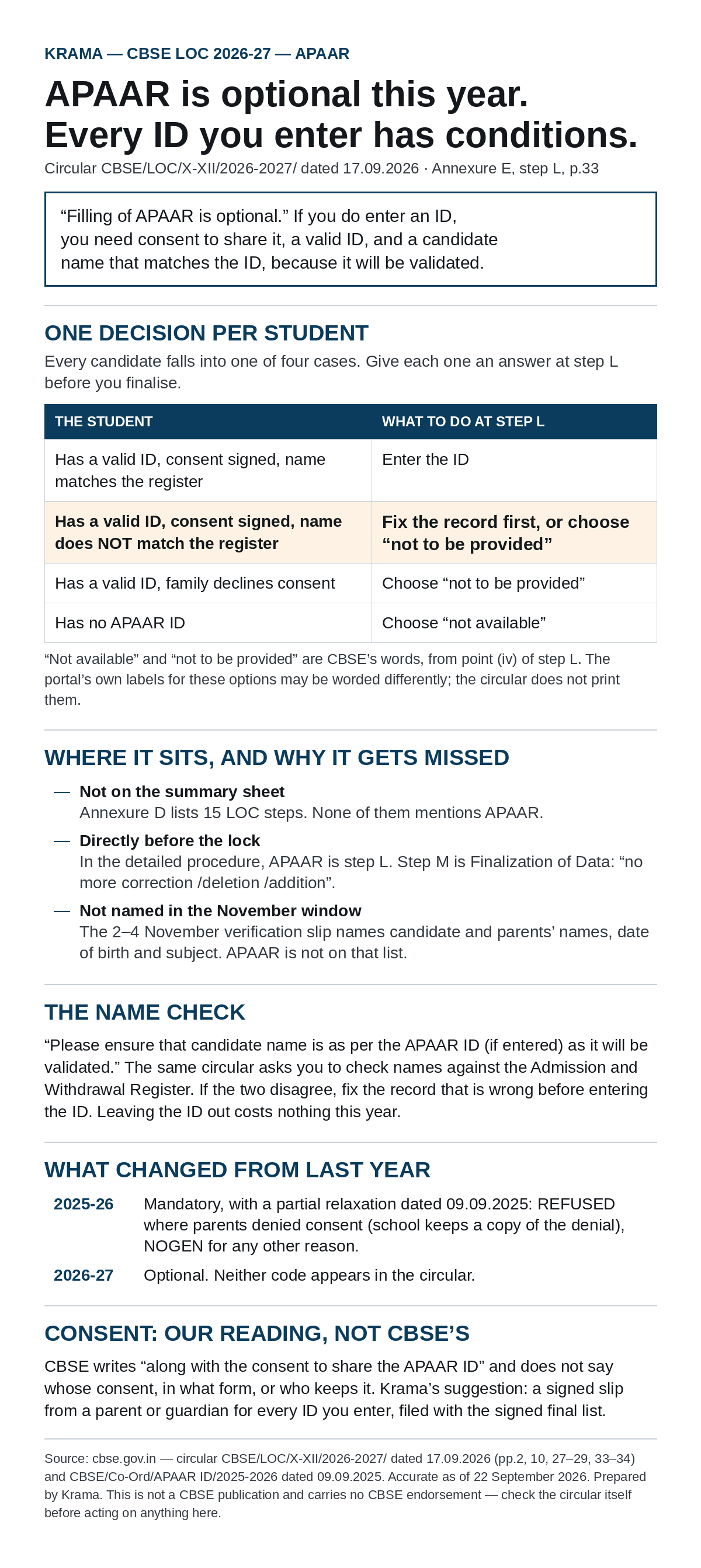
APAAR in the LOC: one decision per student
One page for whoever is filling the LOC. The four cases a student can fall into, what to enter for each, the three conditions that come with entering an ID, and where the step sits before the finalisation lock. Readable without opening this post.
 Download the sheet
Tell me how this went at your school
Replies from principals and coordinators are what shape the next post. If your experience differs from what is written here, I would rather know.