CBSE's two-phase Class 10 board has run once. Your calendar has not caught up.
The first full cycle is finished and the numbers are out. The operational trap is not the exam — it is the LOC schedule, whose first window closes before anyone knows their Phase 1 marks.
The first Class 10 cycle under two board examinations is finished. CBSE declared the second-exam results on 18 July 2026, and for the first time there is something better than speculation to plan against — a full set of numbers for what schools and students actually did with the second window.
The headline figure in the press release is that 96.78% passed after combining both attempts. It is not the figure that should change how you run next February.
5,13,955
students sat the second board exam to improve a Class 10 result they already held.
2,05,860
of them did not improve. CBSE published the two totals; the subtraction is mine.
14days
The first LOC window, 18–31 March, closed before the Phase 1 results were declared.
What the first cycle actually produced
The Main examination ran 17 February to 11 March 2026, the second from 15 to 21 May. The press release gives the split:
| Category | Candidates |
|---|---|
| Registered for the second examination | 6,64,027 |
| Appeared | 6,63,777 |
| Appeared for improvement | 5,13,955 |
| Improved on the main examination | 3,08,095 (59.95%) |
| Appeared in the compartment category | 1,49,822 |
| Passed in the compartment category | 78,503 (52.40%) |
Those reconcile exactly — 5,13,955 improvement plus 1,49,822 compartment is the 6,63,777 who appeared. Do not report a gap that is not there.
The compartment result is straightforwardly good news: 52.40% cleared, against 48.68% in 2025, a comparison CBSE makes itself in a footnote. A second attempt inside the same session, rather than a wait, helps the students who need it most.
The improvement figure is the one worth sitting with. 59.95% of those who reattempted improved. By subtraction — mine, not CBSE's — 2,05,860 students prepared for a second board examination in May and came away with nothing they did not already have. Their result was unaffected, because the better of the two performances is what counts:
The Second Board Examination provided eligible students of the Main Board Examination of 2026 with an additional opportunity to improve their performance. Accordingly, for regular students of the 2026, the better of the two performances is considered for preparing the final result.
So nobody was harmed on paper. What they spent was March, April and half of May — the weeks in which a Class 10 student would otherwise be settling into Class 11 — and your school spent it with them.
CBSE has already told you whose job this is
The instinct is to treat the second exam as a student-and-parent decision the school merely administers. The LOC circular does not read that way. It has a section headed "Expectation from the Principals", and the first item is not administrative:
be guided about rules of Second Board Examinations and use of this facility only in dire need.
"Only in dire need" is CBSE's phrase, in a circular addressed to principals, in the cycle where 2,05,860 reattempts changed nothing. Read alongside the result data, it is a fairly clear statement of where the Board thinks the counselling responsibility sits.
Two more items in that list are pure operations, and they generate parent phone calls if nobody has pre-empted them:
be informed that as examination centres would be limited in number, hence, their examination centre might not be nearer.
no examination centre will be changed once allotted.
Fewer candidates in the second window means fewer centres. A family that assumed the February arrangement repeats in May will find out otherwise, at a point when it cannot be changed.
The LOC schedule is the part that will catch you
Here is the mechanism most schools will meet cold. The 17 March circular sets the submission schedule in three phases:
| Phase | Window | What it is |
|---|---|---|
| 1 | 18–31 March | LOC submission, before results |
| 2 | Day after results are declared, for 5 days | LOC and fee, once marks are known |
| 3 | 7th day after declaration, for 2 days | Late fee |
Phase 1 closes before the Phase 1 results exist. The circular is explicit that this is deliberate — CBSE wants the headcount and the subject split in advance, to make what it calls "the foolproof preparations of the examination" — and it asks principals to push students into that window:
be advised that who so ever wishes to appear in the Second Board Examination because of any reason, they should submit LOC during 1st phase as this will help CBSE in the advanced preparation.
Students can still decide after results and use Phase 2. But note what Phase 1 asks a school to do: collect a declaration of intent from students who do not yet know their marks, in the fortnight after their last paper, and get it right.
One line in that table is easy to read past, and it changes the advice. The examination fee for Phase 1 is not due in March — the circular puts it on the same clock as Phase 2, "next day from the day of declaration of results for 5 days". A Phase 1 entry costs a family nothing until the marks are out. It is an option to hold, not a commitment — which makes submitting broadly in March and counselling properly after results a defensible policy.
That is a real workflow, and it is not one most schools have. It needs a list, a deadline before the students disperse, and a named person. It is also where the counselling CBSE asks for either happens or does not.
One extra trap, easy to miss: compartment candidates cannot simply carry over.
Candidates appeared in the main examinations and placed in compartment, such candidates need to re-submit their LOC afresh as their improvement subject criteria might change.
Who is eligible, and the trap that costs a year
The 14 February notification exists because schools kept asking whether a student who missed the first exam could sit the second. The answer is a firm no, and the consequence is heavier than it first looks:
It is mandatory for all the students to appear in the first Board examination.
If a student has not appeared in 3 or more subject in first examination, then s/he will not be allowed to appear in the 2nd examination. Such students will be placed in the "Essential Repeat" category and can take the examination only next year in the main examinations in the month of February next year.
Three papers missed in February costs a full year. Not a re-sit in May — the main examination, next February. That changes the arithmetic on things your school already manages badly under pressure: a student hospitalised mid-board, a bereavement in the second week of papers, a family emergency that takes out a Thursday and a Friday. Two missed papers and the May window is still open. Three and it is gone.
The notification closes by shutting the door on appeals:
Any request received by CBSE on the above cited subject will not be responded to.
Improvement itself is capped at three subjects, from Science, Mathematics, Social Science and languages.
What locks the moment Phase 1 closes
The same circular lists what cannot be corrected afterwards. These are worth knowing in February, not May:
- No subject change from the first examination to the second, except as permitted by policy for Mathematics.
- No correction to a student's data between the two examinations.
- No new CWSN candidate — only students registered as CWSN in the first examination keep those facilities.
- No new names added to the LOC for the second examination.
A typo in the Phase 1 LOC is therefore a typo you carry through the second examination and onto the certificate. The data-verification step your exam coordinator does in a hurry in December is now doing double duty.
What to decide before February
- Name the owner of the Phase 1 LOC window. It falls in the fortnight after the last paper, when the school is emptying out. Without a name it slips.
- Write your "dire need" guidance now, not in March. You have the cycle-one numbers. A student two marks below a cut-off is a different case from a student hoping to lift a 72 to an 85, and your teachers should be saying the same thing to both families.
- Fix the data-verification step in December. It is now the last point at which a correction is possible for either examination.
- Brief parents on centres before allotment, not after. Limited centres, possibly further away, and no change once allotted.
- Plan May as a working month for the exam team. In 2026 the second examination ran 15–21 May, inside what most schools treat as the start of the new session.
None of this is on a deadline you are currently missing. CBSE has not published the 2027 schedule, and every date above is the 2026 cycle, offered as a planning baseline rather than a forecast. That is why it is worth doing now — the first cycle is the only one you get to learn from before the next one starts, and the window in which to build the process is a quiet one.
The thing I cannot see from the circulars is how the counselling actually went. In your school this year, who decided which students sat the second examination — the exam coordinator, the class teachers, or the families on their own — and would you run it the same way in 2027?
Take this with you
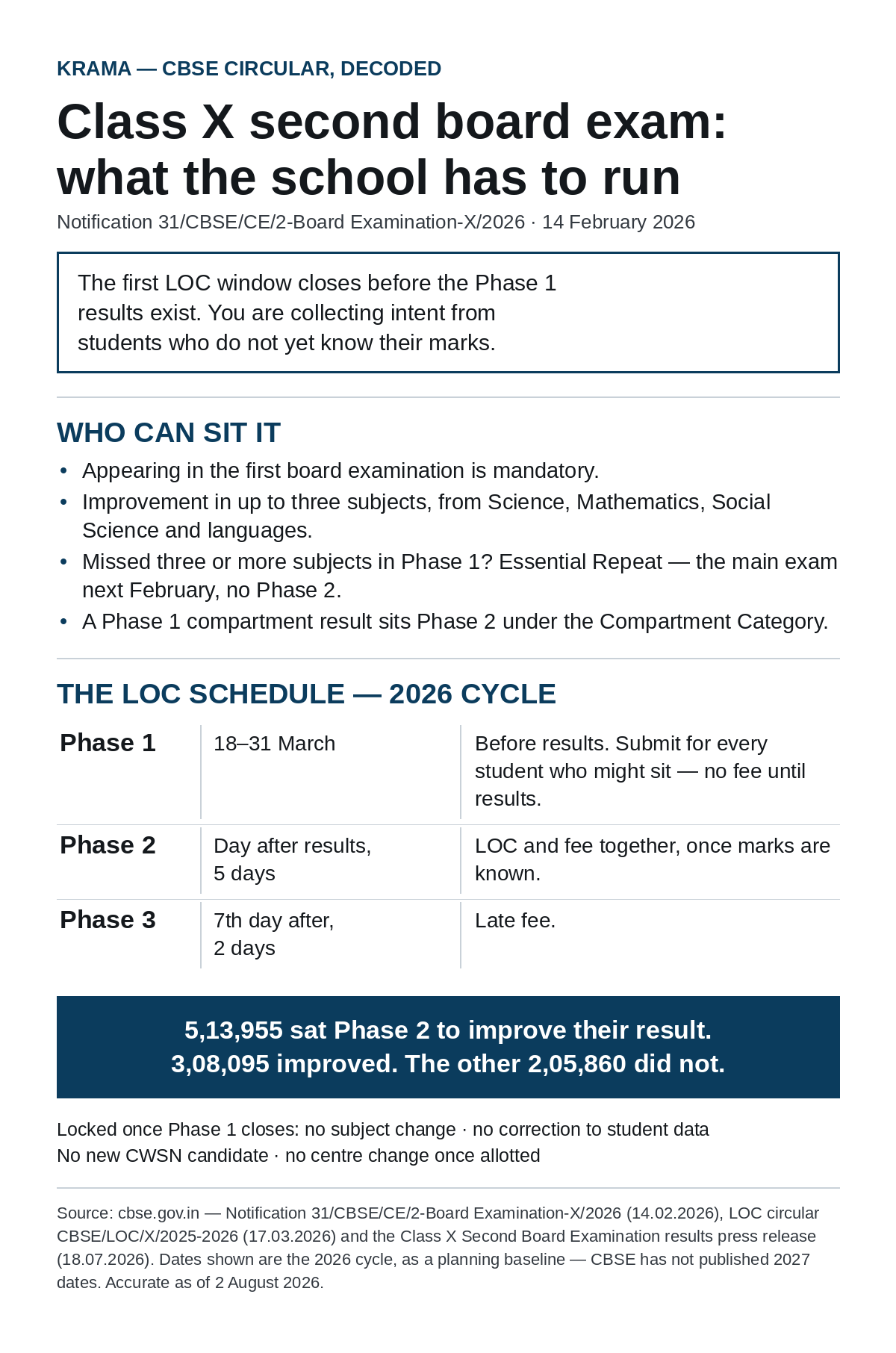
Class X Phase 2: what the school has to run
One page. Who is eligible for the second board exam, the three LOC windows and what each is for, what locks the moment Phase 1 closes, and what the first cycle actually produced. Built to answer a question in January without opening a circular.
 Download the image
Tell me how this went at your school
Replies from principals and coordinators are what shape the next post. If your experience differs from what is written here, I would rather know.