The LOC window opens on 24 September. If you pay by challan, it closes four days early.
CBSE published the 2026-27 List of Candidates circular on 21 September. The last dates sit in two annexure tables at the back, and they differ for the same fee slab depending on whether the school pays online or by challan.
When this site wrote about the Class 10 two-board cycle, it ended on a limitation. Every date in that post came from the 2026 cycle, because CBSE had not yet published a 2027 LOC schedule, and a planning baseline is not a forecast.
That circular is now out. It was listed on 21 September, is dated 17 September and runs to 55 pages. It is also a scan, so you cannot search it, and neither can the people writing summaries of it. What follows is what it asks of the school that has to file.
4 days
shorter if your school pays by challan rather than online, on the same fee slab.
₹2,000
late fee for each candidate, charged on top of the normal fee, so it grows with your cohort.
3 days
to correct a wrong name, date of birth or subject: 2 to 4 November. CBSE allows no correction after that.
The window has two closing dates
The schedule is not in the letter. It is in Annexure A, which CBSE prints as two tables, A(i) on page 15 and A(ii) on page 17. A school that reads the first table and stops will write the wrong date in its diary.
| Paying online | Paying by challan | |
|---|---|---|
| Window opens | 24 Sep 2026 | 24 Sep 2026 |
| Normal fee, last date | 21 Oct 2026 | 17 Oct 2026 |
| Late fee window opens | 22 Oct 2026 | 22 Oct 2026 |
| Late fee, last date | 30 Oct 2026 | 26 Oct 2026 |
Paying by challan shortens both windows by four days. CBSE's footnote gives the reason: a challan can only be generated up to that date, although the money can be deposited while the challan is still valid. Most people filing the LOC will never read that footnote, and the deadline moves for them anyway.
For schools in India the fee is ₹1,600 per candidate for five subjects, ₹320 for each additional subject and ₹160 per practical subject in Class 12. Visually impaired candidates pay nothing. Schools in Nepal pay ₹5,500 and other overseas schools ₹11,000, on the same dates.
The late fee is ₹2,000 per candidate, on top of the normal fee. Work it out against your own numbers before October, because at that size it works like a second fee. A school sponsoring 150 candidates pays ₹2,40,000 on time. If it misses the window, the penalty alone is ₹3,00,000, which is more than the fee it is added to.
Submission closes at 11.59 p.m., and CBSE says the last date for each activity is fixed and will not be extended. Plan on that. CBSE has moved dates before (it extended the Class 12 supplementary LOC date by a separate circular in July), but you cannot schedule your office around an extension nobody has announced.
Eligibility, with the byelaws quoted at you
In Part II, CBSE quotes Affiliation Byelaws para 14.2 word for word. Its six clauses are the grounds on which a sponsorship can be challenged later.
No affiliated school shall present the candidates to the Board's examination, who are on its roll but have not attended the school regularly or do not meet the requirement of minimum attendance for appearance in the Board's examination.
Schools tend to miss the clause that runs the other way. Under 14.2.5 a school must sponsor its bonafide and eligible students regularly and without a break, or tell the Board in writing, with reasons, well in time. If you leave an eligible student off the list, the Board expects to be told why.
Two more conditions are easy to lose in 55 pages. Students must not be registered with any other school education board as well as CBSE. For Class 12, the school must confirm that each candidate passed Class 10 from a recognised board on or before the academic year 2025.
The sponsorship count is now tied to your staffing
This paragraph from Part III will surprise people. CBSE underlines it in the original:
Number of students sponsored by the school should be in proportion to the number of teachers appointed in the school. It will be the responsibility of the school to relieve the teachers for evaluation in accordance with the number of candidates sponsored in each subject. In case, schools will not relieve their teachers, CBSE will be liable to initiate strict action against the school including non-declaration of their results.
In practice, the LOC you file in October commits you to releasing teachers for evaluation months later, in proportion to the candidates you entered in each subject, and CBSE names your results as what is at stake if you do not. Your OASIS data feeds this. Only TGTs and PGTs who actually teach classes 9-10 and 11-12 should be listed as such, teachers who have left must be deleted, and full names must go in without abbreviations. CBSE says an abbreviation will be "considered incorrect data provided by the schools".
One correction window, and it is new
After the last date, the school generates a data verification slip for each candidate. A wrong candidate name, parent's name, date of birth or subject can be corrected between 2 and 4 November 2026. CBSE put the next sentence in capitals:
Once this process and period is over, NO CORRECTION WILL BE ALLOWED BY THE BOARD.
Block those three days now, while the LOC is still being filled. The slip only arrives after the current window has closed, and by then most schools have moved on to other work.
Some things cannot wait for that window. Section and strength, once declared on OASIS, cannot be changed after submission. Requests to change subjects are refused: CBSE notes that many schools ask, and says it will not accept them. CWSN data closes before the LOC last date, so a concession identified in late October comes too late. A direct admission or re-admission into Class 10 or 12 needs Regional Office approval before the name can be added.
Annexure D, incidentally, says it lists steps 1 to 12 and then lists 15. Schools tend to skip the last three: print the final list, have it signed by the parents, the candidate and the principal, and keep the printout. Nothing has gone to the Regional Office since 2021, so that signed sheet is the only record in the building that the family saw the data before it went onto a certificate.
The excuses CBSE has pre-refused
Page 9 has a list that reads like every phone call the Board has taken in October for a decade. CBSE writes that it will not consider any of these: the clerk handling registration left the station after a bereavement without telling the principal; the teacher responsible was unwell or met with an accident; students did not provide their details; a student had stopped coming to school, so the name was missed; the school forgot the final submission.
The instruction that follows is the only one in the circular addressed to the principal personally:
All principals are directed to seek the report from the concerned teacher/official each day from 7 days before the last date about the status of the submission of the LOC and the fee payment.
Seven days before your last date is 14 October if you pay online and 10 October if you pay by challan. CBSE does not print those two dates; I worked them out from its instruction. They still belong in your calendar, because the Board has now put in writing that a late or wrong submission is the principal's responsibility.
Before 24 September
Decide the payment route first, because it sets your deadline
Online or challan is usually a finance decision, made without anyone thinking about the LOC. Here it moves your last date by four days. Decide now, write the date down and tell the person filing.
Update OASIS and HPE before you open the LOC module
You cannot finalise LOC data until the HPE submission is done. That submission generates a confirmation number, which CBSE tells schools to keep. The section and strength you declare on OASIS is the number you are stuck with.
Reconcile last year's Class 9 and 11 list against today's register
The module shows the students you registered last year. Deleting transfers and Class 9/11 failures, and adding direct admissions, are manual checklist steps. Additions also need Regional Office approval, which takes time of its own.
Check spellings against the Admission and Withdrawal Register
CBSE names that register specifically for the student's name, both parents' names and the date of birth, so check against it rather than against the report card or the admission form.
Put 2-4 November in the calendar now
The verification slip arrives after the LOC closes. It is your last chance to correct anything, it lasts three days, and it comes when nobody is thinking about the LOC any more.
I have left one field out of this post: APAAR. It is optional this year. Page 2 says so and page 33 repeats it in CBSE's red text, but the same page adds a consent requirement, and that needs more room than a checklist line. It will get its own post.
The circular does not answer one question. CBSE now expects the number of candidates you sponsor to be in proportion to the teachers you can release for evaluation. For a school with a large Class 12 science cohort and a thin senior faculty, those two numbers do not obviously add up. How is your school planning to reconcile them this year?
Take this with you
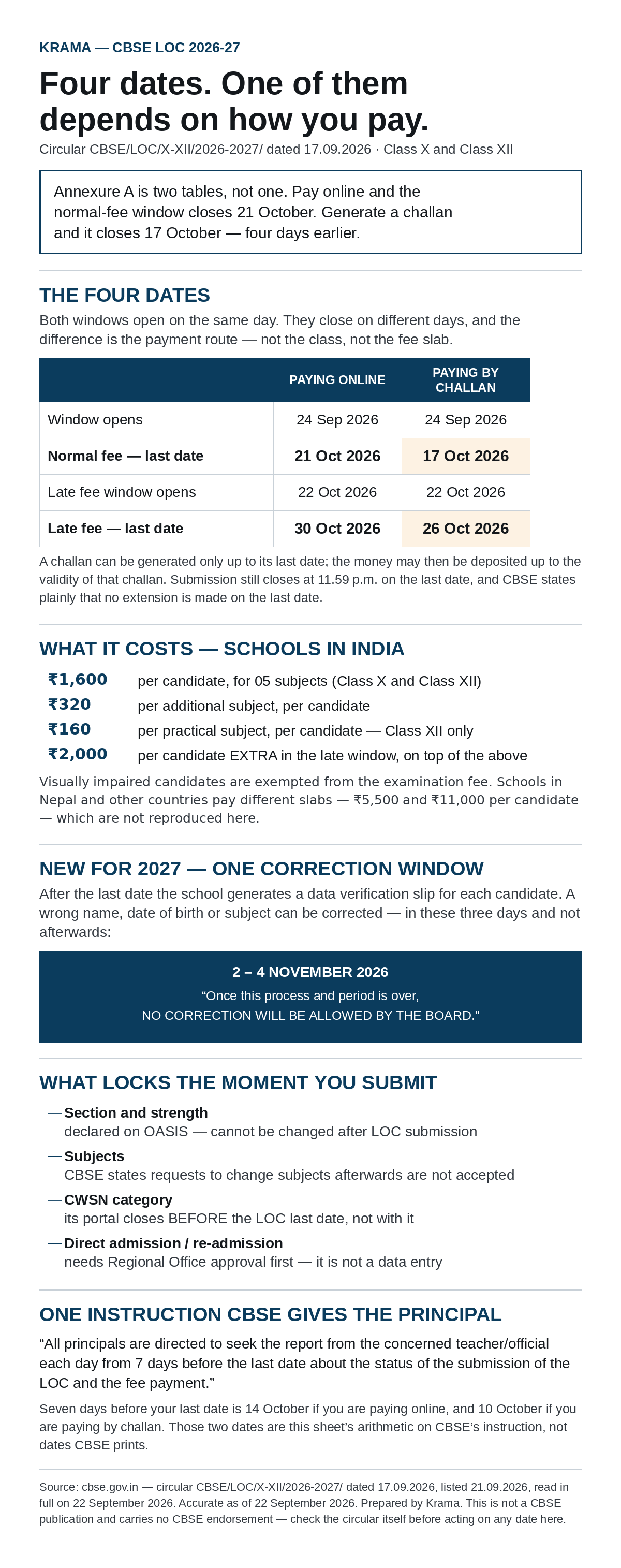
LOC 2026-27: the four dates and what they cost
One page for the desk of whoever has been given the LOC. Both payment windows side by side, every fee slab for schools in India, the three-day correction window, and the four things that lock the moment you submit. Readable without opening this post, which is the point.
 Download the sheet
Tell me how this went at your school
Replies from principals and coordinators are what shape the next post. If your experience differs from what is written here, I would rather know.