CBSE has introduced CT and AI for Classes 3 to 8. Nobody new is teaching it.
The curriculum framework is live from this session and asks for 50 hours a year in the primary classes and 100 in the middle. It also assumes your existing subject teachers will absorb all of it.
On 1 April 2026, CBSE introduced a Computational Thinking and Artificial Intelligence curriculum for Classes III to VIII, effective this academic session. If you missed it, you are in a large majority — it arrived as Circular Acad-15/2026, a page and a half long, in a month when most schools were closing out results.
It is worth reading properly, because the interesting part is not the AI. It is the staffing.
50hrs a year
Classes 3–5, absorbed into Mathematics and The World Around Us. No new period.
100hrs a year
Classes 6–8, split 40 advanced CT · 20 introductory AI · 40 interdisciplinary projects.
1Computer teacher
Assesses all 40 project hours, across three year groups.
What the circular actually says
The operative sentences are short:
CBSE introduces the Computational Thinking (CT) and Artificial Intelligence (AI) Curriculum for Classes III–VIII from the academic session 2026–27.
and, at the end:
All schools are advised to take necessary steps for effective implementation of the curriculum.
Advised. Not "shall", not "mandatory", no compliance date, no submission, nothing to upload. That word is doing a lot of work, and it is the first thing to be clear about with your management: there is no deadline you are currently missing.
What there is, is a fully specified curriculum framework — curricular goals, competencies, learning outcomes, a syllabus, hour allocations — sitting on the CBSE academic site, aligned to NEP 2020 and NCF-SE 2023. Frameworks that arrive in this shape do not usually stay advisory. The schools that will struggle in two years are the ones that read "advised" and filed it.
The numbers
The framework allocates time by stage:
| Stage | Hours per year | How it is delivered |
|---|---|---|
| Classes 3–5 | 50 | Integrated into Mathematics and The World Around Us |
| Classes 6–8 | 100 | Specific AI topics plus interdisciplinary projects |
For the middle stage, the 100 hours break down further: 40 hours of advanced CT skills, 20 hours of introductory AI concepts, and 40 hours of interdisciplinary projects. Those add up exactly, which is a good sign about how carefully the document was put together.
Now the arithmetic the document does not do for you, and which is mine rather than CBSE's: a typical Indian school year runs somewhere around 35 to 40 teaching weeks once you take out exams, holidays and the days that evaporate. One hundred hours across 36 weeks is a little under three hours a week. Fifty hours is closer to one and a half.
Three hours a week, in Classes 6, 7 and 8, is not a rounding error. It is a timetable decision.
Where those hours are supposed to come from
Here is the sentence in the framework that a principal should read twice:
The above time allocation is suggested to maintain the existing curriculum load and ensure balance without overburdening students with additional content.
Read plainly: this is not meant to add periods. The hours are meant to come out of periods you already have. For Classes 3–5 that is explicit — CT is "integrated with the existing textbook content, with additional CT questions and activities added into appropriate chapters" of Mathematics and TWAU.
So the student's day does not get longer. But the content inside the Mathematics period does get denser, and the person absorbing that density is your Mathematics teacher. "Without overburdening students" is not the same sentence as "without overburdening teachers", and the framework does not make the second claim anywhere.
Who actually teaches this
The framework is unusually direct about staffing, and this is the part worth putting in front of your heads of department.
Classes 3–5. CT is taught "as part of Mathematics and other subjects by subject teachers", using worksheets and handbooks that follow the same chapter sequence as the existing textbooks. There is no CT teacher. There is no CT period. Your Class 4 Mathematics teacher is the CT teacher, whether or not that has been discussed with her.
Classes 6–8. Delivery is explicitly collaborative: subject teachers handle the CT resources, and Computer teachers handle the AI literacy component. The middle stage splits into intermediate CT and introduction to AI literacy, and then:
Projects integrating concepts from both CT and AI will form a key part of the learning process and will be assessed by the Computer teacher.
That last clause is the one to cost out. Forty of the hundred hours are interdisciplinary projects. Those projects are cross-subject by design — drawing on Mathematics, Science, Social Studies and English — which means someone has to coordinate across four departments. And the assessment of all of them, across three year groups, lands on the Computer teacher.
In most schools I would expect that to be one person. Possibly one person who is also running the computer lab, the school website, the OASIS data entry and whatever the exam portal needs that week.
What it does not require
Worth being equally clear about, because this is where vendors will arrive.
The framework recommends "harnessing free and open-source tools to ensure accessibility and adaptability for all institutions", and states that the whole approach is "without dependence on any specific platform". Resource books and teacher manuals for both stages are to be provided.
So: no prescribed platform. No licence you must buy. No lab you must build. If someone shows up quoting Acad-15/2026 as the reason you need a subscription per student, the circular does not say that and neither does the framework.
That is not an accident of drafting. The pedagogy section asks for puzzles, structured problems, demonstrations, practice sessions, discussions, debates and reflective exercises — and CBSE's follow-up circular on the resource books, Acad-18/2026, describes the curriculum as comprising "CT + AI + Ethics + Unplugged Learning". Note what that phrase is describing: the composition of the curriculum, not an obligation on your school. But it tells you something useful about delivery.
Unplugged means exactly what it sounds like. A meaningful share of computational thinking at this level is taught with paper, a blackboard and a well-chosen problem — decomposition, pattern-spotting, writing precise step-by-step instructions. A school with eight working machines and a shared projector is not disqualified from teaching this well. That is worth saying plainly to any management committee that reads "AI curriculum" and immediately starts costing hardware.
There was also a CBSE webinar for teachers of Classes III–VIII on 28 April 2026, circulated as Acad-23/2026. If your teachers missed it — most did, it was a Tuesday afternoon in April — it went out on YouTube, and the link in that circular is the cheapest teacher briefing available to you right now.
What to decide before your next timetable cycle
The honest sequence, in order:
- Name the owner. Not a coordinator for AI — an owner for CT and AI across 3 to 8. Without one this becomes nobody's job by October.
- Find the 40 project hours in Classes 6–8 before you find the other 60. The 20 AI hours will happen; the Computer teacher will teach them. The 40 project hours are the ones that quietly do not.
- Ask your Computer teacher what the assessment load looks like for three year groups of interdisciplinary projects, before you agree to it on their behalf.
- Brief your Mathematics and TWAU teachers for 3–5 explicitly. They are now delivering this. They should hear it from you rather than discovering it in a worksheet.
- Wait on procurement. The resource books are coming from CBSE.
None of this is urgent in the compliance sense. There is no date. That is exactly why it needs a decision now — nothing forces it, so it will drift, and the drift is invisible until a parent asks what your school is doing about AI and the answer is a webinar nobody attended.
I am curious about one thing in particular, because the framework is silent on it: in your school, is the Computer teacher's project assessment load for Classes 6 to 8 something you can absorb with the staff you have, or does this need a hire?
Take this with you
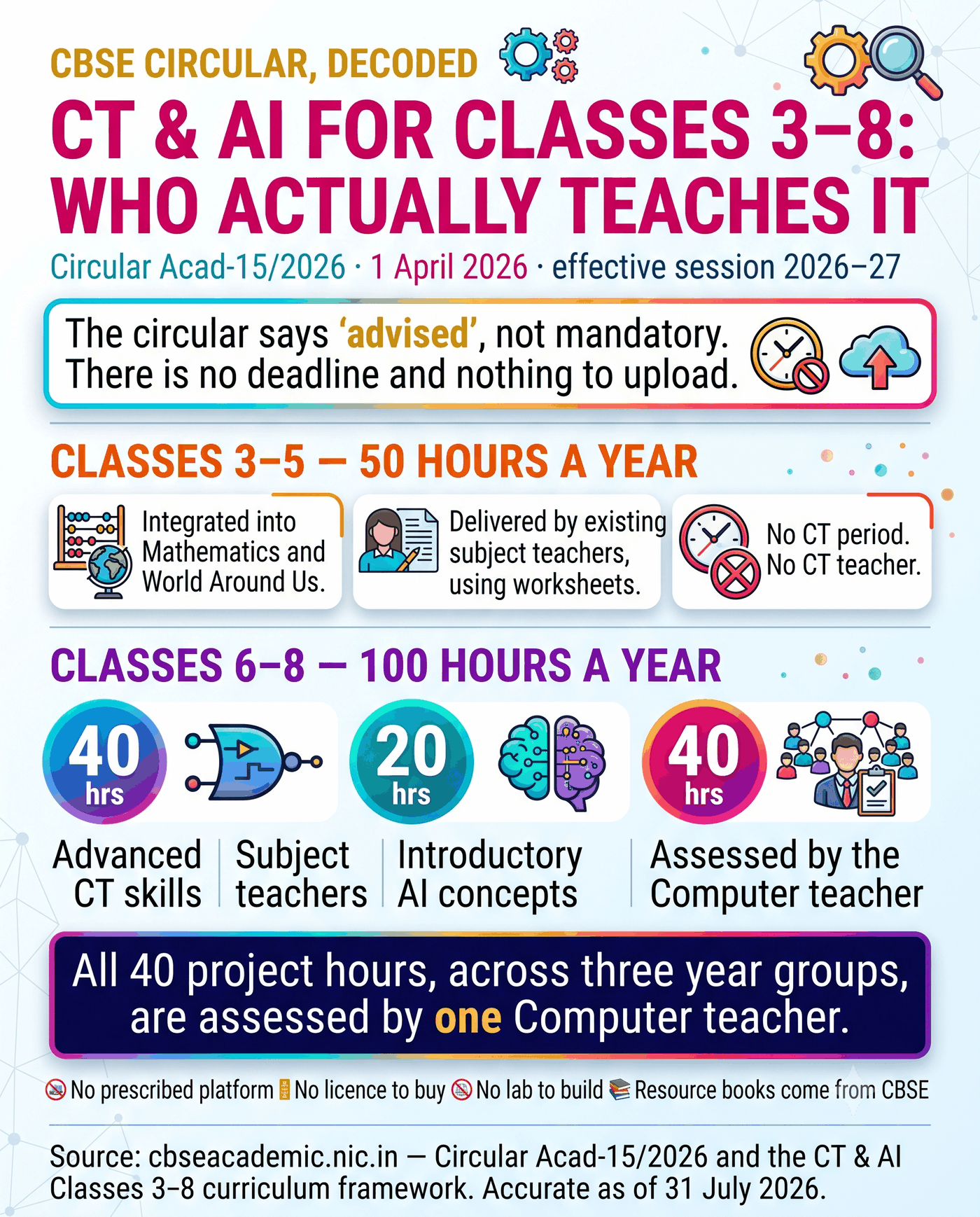
CT and AI Classes 3-8: who teaches what
One page. That the circular says "advised" and sets no deadline, the hour split for Classes 3-5 and 6-8, which teacher owns each component, and who carries the assessment. Readable without opening the post, which is the point.
 Download the image
Tell me how this went at your school
Replies from principals and coordinators are what shape the next post. If your experience differs from what is written here, I would rather know.