The third language arrived mid-session. Your Class 9 timetable did not.
CBSE made R3 compulsory for Class IX from 1 July, after an April notification said it would not apply until 2029-30. Both documents are still on the site. The operational load is a 100-mark internal assessment and a certificate nobody can be awarded without it.
On 9 April, CBSE answered a question schools had been asking since the Class IX–X curriculum was released a week earlier. Did the three-language scheme in the new NCERT syllabus apply to Class IX now?
R3 — Not applicable till the academic session 2029-30 at the class IX level
That is an unambiguous answer, in an official notification, and a great many schools built a Class IX timetable on it. It was wrong five weeks later.
1 July
R3 became compulsory for Class IX. The guidelines explaining how to run it arrived on 10 July.
40of 100
marks in R3 are listening and speaking, assessed across eight activities per student.
0
board examinations for R3 — and no Class X pass certificate without clearing it.
Three documents, three different answers
The sequence matters more than any single circular, because the document a principal happens to find first determines what the school does.
| Date | Document | What it says about R3 in Class IX |
|---|---|---|
| 2 April | Curriculum released (Acad-14/2026) | NCF-2023 scheme of studies begins in Class IX this year |
| 9 April | Notification on languages | Not applicable till 2029-30 |
| 15 May | Circular Acad-33/2026 | Compulsory with effect from 1 July 2026 |
| 2 July | Circular Acad-46/2026 | Assessment framework: 100 marks, school-based |
| 10 July | Circular Acad-49/2026 | Consolidated guidelines — the one that governs |
The 9 April notification has not been taken down. It was still listed on the CBSE academic site when this post was checked, and nothing on it says superseded. A principal reading carefully can still arrive at exactly the wrong answer, in good faith, from CBSE's own website.
If you take one thing from this post: the document that governs is Circular Acad-49/2026, dated 10 July 2026. Anything earlier is history.
The requirement landed before the instructions did
Acad-33 made three languages compulsory from 1 July. It also asked schools to update their R3 offering on OASIS by 30 June, and promised detailed guidelines by 15 June.
The guidelines did not arrive on 15 June. The assessment framework came on 2 July and the implementation guidelines on 10 July — nine days after the requirement they explain had already taken effect. In between, Acad-33's instruction was to teach Class IX from the Class VI R3 textbook, supplemented with a local literary text the school chose itself.
That stopgap is now spent — NCERT has released Class IX R3 learning resources, and Acad-46 points schools to them. But it is worth naming what the first six weeks looked like: schools were asked to teach a compulsory subject before its textbook, its assessment scheme, or its rules existed.
What actually changed for your timetable
Strip the politics out and one structural fact does the damage: the third language used to stop at Class VIII. Classes IX and X were two languages. That is the pattern every existing Class IX timetable was built around.
Now R3 continues into IX and X. For Class IX 2026-27, Acad-49 is specific about where it comes from:
The students of class IX (2026-27) will continue the same 3 language combinations that they studied in the Class VIII in the previous year. Out of these three languages, 01 language will be opted for as R3.
So for most schools this is not a new subject to choose. It is a subject that was supposed to end and did not — a period, for two years, for every student in the section.
Three situations, and Acad-49 handles each:
Already two Indian languages
Hindi and Tamil, say. The third can be anything.
One Indian language, one non-native
Tamil and English. R3 must be an Indian language.
Two non-native languages
English and French — the case that would have forced a drop, and the one CBSE relaxed. A student already in Class IX may keep both and add one Indian language.
Class X in 2026-27 is untouched. Acad-49 reiterates that this batch continues on the old two-language system and takes no third language at all — worth saying out loud to a Class X parent who has read the news and assumed otherwise.
The assessment is where the work actually is
Acad-46's framework is 100 marks, entirely school-based, built on what it calls an Oral-First Pedagogy — listening and speaking before reading and writing.
| Component | Marks |
|---|---|
| Listening and speaking | 40 |
| Creative writing | 15 |
| Reading, from the learning resource | 20 |
| Writing, from the learning resource | 10 |
| Project work | 15 |
| Total | 100 |
The 40-mark section is the one to look at properly. It is eight activities per student, five marks each, assessed across the year from a suggested list — describe a picture, narrate a personal experience, retell a story, role play, debate. The project carries a five-mark viva, also per student.
None of that can be marked from a stack of answer scripts on a Sunday. It is assessed in the room, one student at a time, and recorded well enough to defend.
The following arithmetic is mine, not CBSE's, and the school is hypothetical. Take four sections of forty. Eight oral activities each is 1,280 individually assessed performances in a year, plus 160 vivas, for a subject that did not exist in this class in March. Run your own numbers before somebody assumes this fits in the gaps of an existing workload.
A school mark that gates a board certificate
This is the part that has had the least attention and carries the most risk.
There is no board examination for R3. Acad-49 says so twice. But:
students need to clear R3, i.e., the third language, in the school-based assessment in Class X for the award of the CBSE Secondary School Examination Pass Certificate. Students who are unable to qualify in R3 in Class X shall be reassessed by the concerned school before the declaration of the Class X result.
And a Class IX failure does not disappear at promotion:
In case, a current Class IX student does not qualify the school-based assessment of R3 in the academic year, the student will still be promoted to Class X for the academic session 2027–28. However, the student would need to clear the Class IX R3 assessment while studying in Class X.
Read those together. A mark awarded by your own teacher, under a rubric your own school applies, now stands between a student and a CBSE pass certificate — with no board examination behind it to override or absorb the decision. A Class IX shortfall becomes a Class X liability the school has to track for a year and clear before results.
That is a records problem before it is a teaching problem. Whatever holds your internal assessment marks needs to carry an R3 outcome per student per year, with the evidence attached, and survive a teacher leaving in between.
The honest part
This policy is contested and it may move again. Tamil Nadu's Chief Minister has called the curriculum an attempt at linguistic imposition, school associations in Karnataka have opposed it, and it has been challenged in the Supreme Court. On reporting of the 14 July hearing, the Court declined to stay it for 2026-27 and issued notice — pending, not decided.
CBSE has also revised the scheme once already, and every revision so far has moved toward relaxation: the Situation 3 carve-out above did not exist in the May circular.
So the fair summary is that R3 binds your school today, and the load could still be reduced later. The practical response is not to guess which way it goes. It is to make the decisions you take now cheap to reverse — which mostly means preferring the staffing routes CBSE itself lists over a permanent hire:
Schools are required to engage existing teachers (with functional proficiency), retired teachers, postgraduates, or use Sahodaya clusters (inter-school sharing) and virtual/hybrid teaching.
An inter-school arrangement through your Sahodaya complex costs you a conversation. A post you create in August is much harder to unwind in January.
What to settle this month
- Name the person who owns R3 records. Not who teaches it — who can produce a per-student outcome for it in eighteen months.
- Check your OASIS entry is right. The deadline was 30 June. If it was filed in a hurry against the 9 April understanding, it is wrong.
- Write the eight oral activities into the calendar now, spread across the year. Eight per student cannot be recovered in February.
- Decide the evidence standard before the first activity, not after a parent disputes a mark on a subject with no board paper to point at.
- Tell your Class X parents this does not apply to them. That call is coming either way.
The circulars tell me what schools were asked to do. They do not tell me what schools actually did in the ten days between the deadline and the guidelines. When R3 started in your Class IX on 1 July, who ended up teaching it — an existing teacher with functional proficiency, a shared arrangement through your Sahodaya complex, or nobody yet?
Take this with you
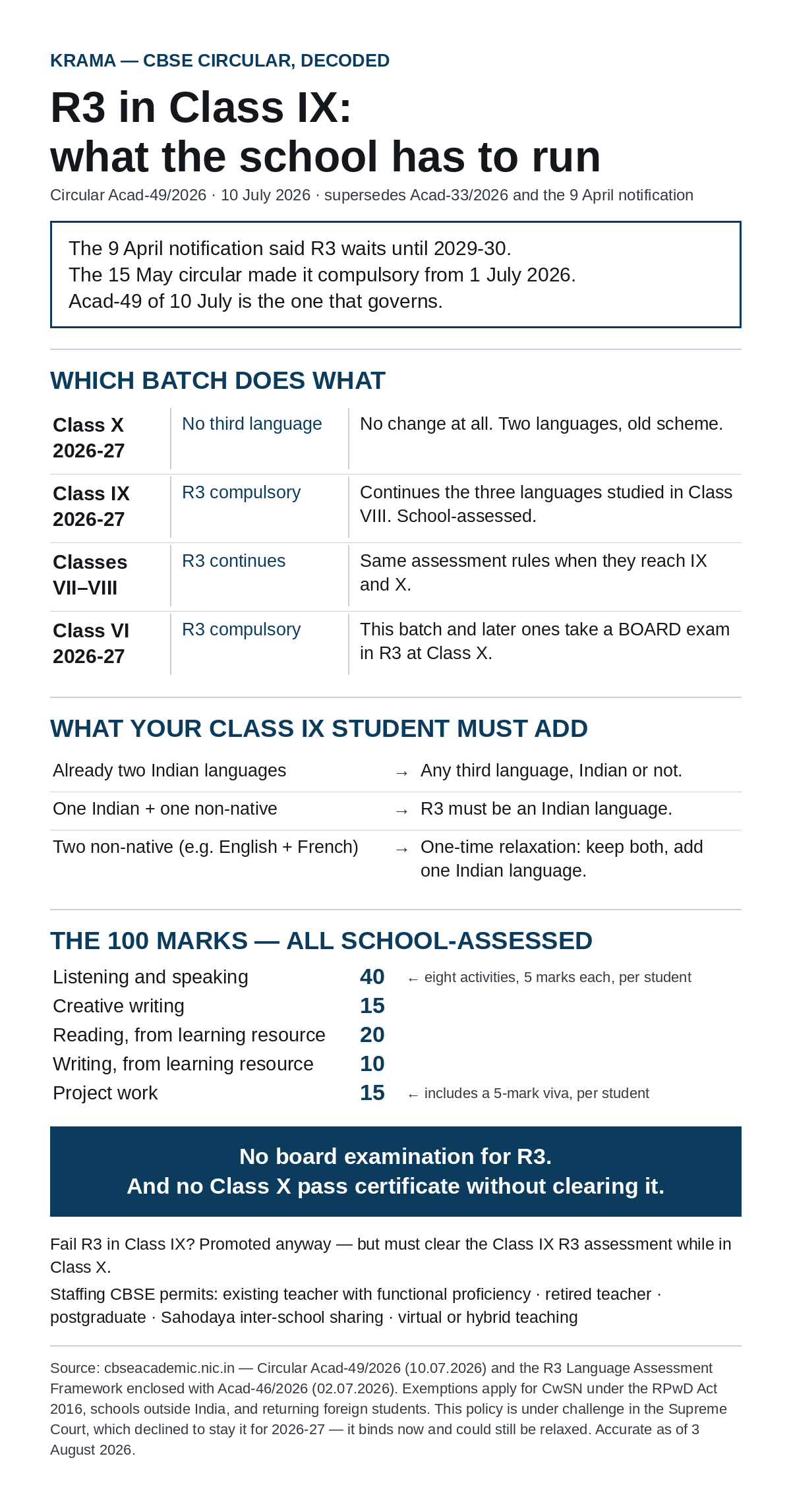
R3 in Class IX: what the school has to run
One page. Which batch has to do what, the three situations a Class IX student can be in and what each must add, the 100-mark assessment split, the certificate gate, and the staffing options CBSE actually permits. Built to answer a question in a corridor without opening a circular.
 Download the image
Tell me how this went at your school
Replies from principals and coordinators are what shape the next post. If your experience differs from what is written here, I would rather know.