What a competency-based question actually looks like: ten rewrites
CBSE's question papers for 2026-27 Class 10 are out, with the files dated 21 and 22 September, and they show item by item what separates a competency question from a recall one. Here are ten ordinary questions rewritten the same way, across four subjects, with answers.
A school asked to make its tests "competency-based" often gets a percentage and no examples. CBSE has now supplied the examples. The 2026-27 Class 10 sample papers are now on CBSE's academics site, their files dated 21 and 22 September, and every page of the Science paper carries the same footnote:
There is no change in the Question Paper Design and Assessment Pattern for Academic Session 2026-27.
So the split is last year's. For Class 10 Science, the curriculum sets 50% for "Demonstrate Knowledge and Understanding", 30% for "Application of Knowledge/Concepts" and 20% for "Formulate, Analyze, Evaluate and Create". Mathematics uses a different scale, which our half-yearly blueprint post sets out subject by subject. What the sample papers add is what those bands look like on the page.
10
recall questions below, rewritten as competency items across four subjects.
50%
of the Class 10 Science paper that is still knowledge and understanding. Recall has not gone away.
4
moves most of the rewrites use. Each one is visible in CBSE's own sample items.
What makes a question competency-based?
A competency-based question asks a student to use what they know in a situation they have not seen, instead of repeating it. In CBSE's 2026-27 sample papers, most such items make one of four moves: they describe a new situation, give data to read, ask for a prediction with a reason, or set a real piece of writing to fix. The content being tested is usually the same as in a recall question.
That last point matters for a department. You do not need a new syllabus to write these. Take the question you already set, keep the concept, and change what the student has to do with it.
Every question below is ours, not CBSE's. Each rewrite names the sample paper item whose format it follows, so you can open the paper and compare.
Science
1. Pollination
Before. Define self-pollination.
After. A gardener covers an unopened pea flower bud with a paper bag and leaves it alone. On a second plant, she removes the anthers from a bud first, then covers it the same way. Which bud is more likely to form a pod? Give a reason.
Answer: the intact bud. Pea flowers can pollinate themselves inside the bag; the second bud has no pollen and nothing can reach it. Modelled on Science Q4.
2. Energy in a food chain
Before. State the ten per cent law.
After. In the food chain grass → grasshopper → frog → snake, the snake receives 2 kJ. How much energy did the grass capture? Why do food chains rarely have more than four or five levels?
Answer: 2,000 kJ. At about 10% per step, too little energy is left to support another level. Modelled on Science Q14.
3. Conduction of heat
Before. List two properties of metals.
After. Rods of copper, aluminium and iron, all the same length and thickness, each have wax at one end and are heated at the other. The wax drops after 12 seconds on copper, 18 on aluminium and 30 on iron. Rank the metals as conductors of heat. If the iron rod had been twice as thick, could you still compare it fairly? Why?
Answer: copper, then aluminium, then iron. No: thickness changes the result, so only one thing may differ between the rods. Modelled on Science Q28, which builds a fair-test sub-question on the same set-up.
Mathematics
4. A pair of linear equations
Before. Solve x + y = 5 and x − y = −1.
After. Riya solved a pair of linear equations and found their only solution was (2, 3). One equation was x + y = 5. Which of these could have been the other? (I) 2x + 2y = 10, (II) x − y = −1, (III) 3x − y = 3.
Answer: II and III. Both pass through (2, 3). I is the same line as x + y = 5, so the pair would have infinitely many solutions, not one. Modelled on Maths Standard Q3.
5. Arithmetic progressions
Before. Find the 17th term of the AP 50, 60, 70, …
After. Meera saves ₹50 in the first week and ₹10 more each week after that. In which week does her weekly saving first go above ₹200? Will she ever save ₹1,000 in a single week within one year?
Answer: week 17, when she saves ₹210 (week 16 is exactly ₹200). No: in week 52 she saves ₹560. Modelled on the case study format of Maths Standard Section E, where each case carries three sub-parts of 1, 1 and 2 marks.
6. Tangents to a circle
Before. Find the length of a tangent drawn from a point 13 cm from the centre of a circle of radius 5 cm.
After. A lamp post P stands 13 m from the centre of a circular pond of radius 5 m. Two straight paths from P just touch the edge of the pond. How long is each path? If a third path ran from P straight to the centre, how much of it would be over water?
Answer: 12 m each. 5 m of the third path is over water. Modelled on Maths Standard Q37, the tangents to a circular garden.
Social Science
7. Power sharing
Before. What is power sharing?
After. In Belgium, Dutch speakers are the majority. Yet the constitution gives the central government equal numbers of Dutch-speaking and French-speaking ministers. (i) Why would a majority agree to that? (ii) Sri Lanka's 1956 Act made Sinhala the only official language. How did the two choices differ in what they did to the minority?
Answer: (i) to keep the minority inside the system and avoid a split. (ii) Belgium shared power with its minority; Sri Lanka's Act favoured the majority and left Tamil speakers feeling excluded. Modelled on the case based questions in the Social Science paper, which carry "three sub questions and are of 4 marks each".
8. Resources
Before. Define a potential resource.
After. Rajasthan and Gujarat receive a great deal of sunlight, but much of it is not yet used to generate power. What kind of resource is solar energy there? What would have to happen for it to count as a developed resource?
Answer: potential. It becomes developed once it has been surveyed, its quantity worked out, and it is being used. Modelled on Social Science Q10, which asks which category a known but unused mineral deposit belongs to.
English
9. Grammar in a real text
Before. Change into the passive voice: The librarian will collect the books.
After. This line is from a school notice. Identify the error and write the correction: "The library will remain closed on Friday, and all books must returned by Thursday."
Answer: "must returned" should be "must be returned". Modelled on English Q3 V, which asks students to "Identify and correct the error in the given line from a technical report".
10. Writing to a purpose
Before. Write a paragraph on healthy eating.
After. The school is choosing between a packaged-snack counter and a fruit counter for its canteen. Notes: the snack counter costs less to run and sells more; the fruit counter produces less plastic waste but needs a staff member every day. Write an analytical paragraph of 100 to 120 words evaluating which the school should choose.
Answer: any clear recommendation that weighs cost and sales against waste and staffing. The marks go to the weighing. Modelled on English Q5 B, an analytical paragraph written from SWOT notes "in 100-120" words.
How to use these in your department
Take one recall question per chapter you are about to test
Do not start from a blank page. The rewrite keeps the concept and changes the task.
Pick one of the four moves
A new situation, data to read, a prediction with a reason, or a real text to fix.
Check it against the sample paper
Open the 2026-27 paper for your subject and find the nearest item. If nothing there looks like your rewrite, ask whether the board would set it.
Write the answer before you set the question
Several rewrites above only work because a detail is fixed: same thickness, only one solution. Writing the answer finds the gap.
Keep the recall questions too
Half the Science paper is still knowledge and understanding. The aim is the right mix, not zero recall.
If a periodic test in your school has to be competency-based, which subject finds the rewrite hardest, and why?
Take this with you
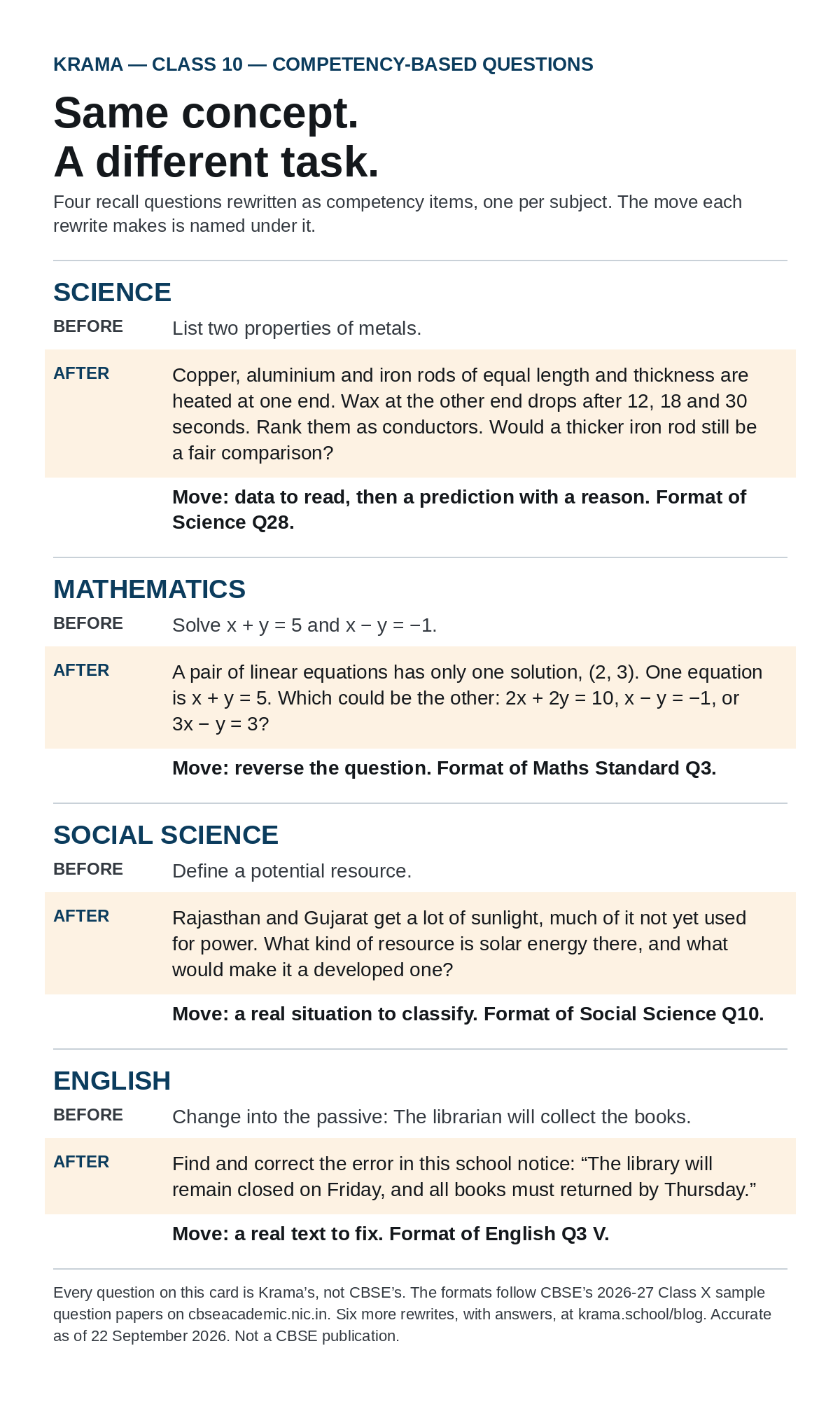
Recall to competency: four rewrites on one card
Four before-and-after pairs from this post, one per subject, with the one move each rewrite makes. Sized to forward to a department group and read on a phone.
 Download the image
Tell me how this went at your school
Replies from principals and coordinators are what shape the next post. If your experience differs from what is written here, I would rather know.